
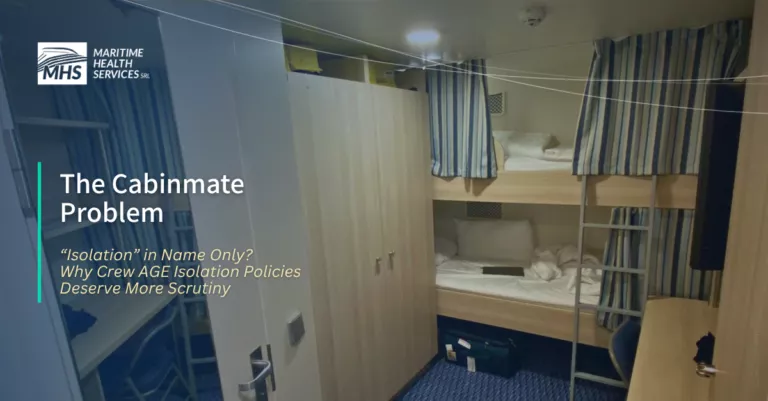
“Isolation” in Name Only? Why Crew AGE Isolation Policies Deserve More Scrutiny
Isolation is one of the most basic principles in communicable disease control.
The concept itself is straightforward: if someone is infectious, separating them from healthy individuals reduces the risk of further transmission.
Within the cruise industry, that principle is firmly embedded in both company procedures and regulatory guidance. Crew members experiencing symptoms of acute gastroenteritis (AGE) are removed from work duties, confined to their cabins, and monitored until cleared by the vessel’s medical staff.
On paper, the process is clear. In practice, however, a substantial number of crew placed under “isolation” for AGE continue to share a cabin with uninfected colleagues throughout the duration of their illness.
For a public health measure fundamentally built around separation, that contradiction is difficult to ignore.
The Definitions Are Clear
Cruise ship public health guidance leaves little room for ambiguity.
The 2025 Vessel Sanitation Program Environmental Public Health Standards defines isolation as:
“The separation of persons who have a specific infectious illness from those who are healthy and the restriction of ill persons’ movement to stop the spread of that illness.”
Similarly, EU SHIPSAN’s 2026 European Manual for Hygiene Standards and Communicable Disease Surveillance on Passenger Ships defines isolation as:
“Separation of ill or contaminated persons or affected baggage, containers, conveyances, goods or postal parcels from others in such a manner as to prevent the spread of infection or contamination.”
Both definitions rest on the same fundamental principle: the separation of the sick from the healthy. Not simply restricting movement but physically segregating infectious individuals from those who are well.
Yet across much of the industry, that distinction has become increasingly blurred.
The Operational Reality
On cruise ships, most crew accommodation is designed around shared occupancy.
Cabins are compact, storage space is limited, and bathrooms may even be shared between adjoining cabins. Under these conditions, maintaining effective separation between a symptomatic AGE case and a healthy roommate becomes difficult to realistically achieve.
Norovirus, the leading cause of AGE outbreaks at sea, is a highly contagious disease. Transmission commonly occurs through direct person-to-person contact, contaminated surfaces, and microscopic viral particles generated during vomiting incidents.
In simple terms, the cabinmate is placed at significantly increased risk of becoming ill.
Although medical staff monitor the close contacts of an AGE case as part of their response, exposure may already have occurred before symptoms are even reported to them. Continuing shared accommodation throughout the isolation period only prolongs that exposure, while placing healthy cabinmates in a situation they have little practical ability to control.
One common industry defence of shared-cabin isolation is that crew are provided with disinfectants and instructed to sanitise surfaces themselves to prevent such transmission.
Expecting someone actively experiencing vomiting or diarrhoeal symptoms to consistently maintain effective environmental hygiene is unrealistic. Instead, the burden of cleaning often shifts onto the healthy cabinmate.
The reality is that the industry has accepted a version of “isolation” that no longer fully aligns with its public health definition. That acceptance extends beyond cruise operators. Public health authorities responsible for inspecting compliance against their own guidance have also allowed these arrangements to persist largely unchallenged.
Why Does This Continue?
The reasons are largely structural.
Cruise ships operate with limited spare accommodation capacity, particularly for crew. Providing dedicated single-occupancy isolation cabins is both challenging for vessels currently in operation and commercially inefficient. Even when passenger cabins are available, allocating them for crew isolation introduces additional logistical and financial challenges.
Questions quickly emerge:
- Who authorizes passenger cabin use?
- What happens during full-occupancy voyages?
- How many isolation cabins should realistically be maintained?
These are legitimate operational considerations. However, they do not eliminate the underlying infection control concern.
During the COVID-19 pandemic, cruise operators implemented enhanced isolation measures and maintained contingency accommodation capacity for communicable disease management. Almost all of that flexibility has since been scaled back as the industry returned to normal operations.
While some allowances can be reasonably made for vessels already in service, newer—and in many cases larger—ships continue to be constructed without any designated isolation cabins.
In effect, the industry has settled into a compromise position: maintaining the procedural appearance of isolation while accepting that physical separation does not always occur.
The Regulatory Blind Spot
This compromise naturally extends into the question of regulatory oversight.
If isolation is clearly defined within public health frameworks as separation from healthy individuals, why do shared-cabin arrangements remain so prevalent in day-to-day operations?
Regulators may not explicitly endorse shared occupancy during AGE isolation. Nonetheless, the absence of regulatory findings related to these arrangements inevitably creates the perception that they are tolerated.
Maritime public health authorities operate within the practical realities of the cruise environment. They understand the limitations of onboard accommodation and the challenges associated with providing dedicated single-occupancy isolation spaces at scale.
There is also likely recognition that strict enforcement of single-cabin isolation standards would carry significant operational and commercial implications, particularly for vessels not originally designed with that capacity in mind.
At the same time, it is important to acknowledge that public health organizations such as the Vessel Sanitation Program (VSP) and EU SHIPSAN operate in close collaboration with the cruise industry. Moreover, these programs are funded, at least in part, by the cruise lines they oversee; in the case of the VSP, entirely through inspection fees. Such arrangements are not unique to cruising, but they can make consistent enforcement of certain standards more politically and practically complex.
If isolation is formally defined as separation from healthy individuals, at what point does continued acceptance of shared-cabin isolation begin to erode the meaning of the standard itself?
This is not about attributing blame to public health inspectors. Rather, it reflects a broader dynamic in which regulatory frameworks can gradually align with operational norms, particularly when a challenge is widespread and well established within existing shipboard operating models.
The risk is that practices become normalised not because they fully reflect the intent of infection prevention guidance, but because they have become operationally familiar and the gap between standard and practice is no longer actively challenged.
The Risk of Normalisation
The limited scrutiny surrounding this issue is, to some extent, understandable given how closely acute gastroenteritis has become associated with cruising in the public imagination.
Norovirus outbreaks, in particular, have long been framed as an almost inevitable feature of cruise operations. As a result, many of the practices developed to manage these events have become deeply ingrained over time, often persisting simply because they are now part of routine operational practice and difficult to eliminate entirely.
Yet familiarity should not lower the standard applied to infection prevention principles.
In most other communicable disease contexts, continued cohabitation between an infectious individual and a healthy roommate would not typically be considered acceptable isolation practice. That inconsistency matters.
Public health terminology is not neutral. When policies state that crew members are “isolated,” there is a reasonable expectation that physical separation from healthy individuals is genuinely being achieved.
If the reality onboard diverges significantly from that expectation, it is fair to question whether the terminology still accurately reflects the practice it describes.
A Conversation Worth Having
Isolation remains one of the most fundamental tools in communicable disease prevention and control.
For that reason alone, it deserves periodic re-examination, particularly in environments where operational constraints make consistent physical separation difficult to guarantee.
The cruise industry has made considerable progress in many areas of public health since its inception. But progress also depends on the willingness to critically reassess long-standing conventions that may have gradually become accepted without ever being fully resolved.
If infected crew members routinely continue sharing cabins with healthy roommates during isolation, it may be time for the industry to reassess whether current practices still reflect the standard isolation is intended to represent.
That may not be a comfortable discussion for everyone involved. But it is precisely the kind of discussion that drives meaningful progress in public health practice.